top of page

Berlin Holocaust Memorial
By Andrew Boer | April 30th, 2026
Thoughts on Metaphor, Duality, and Meaning
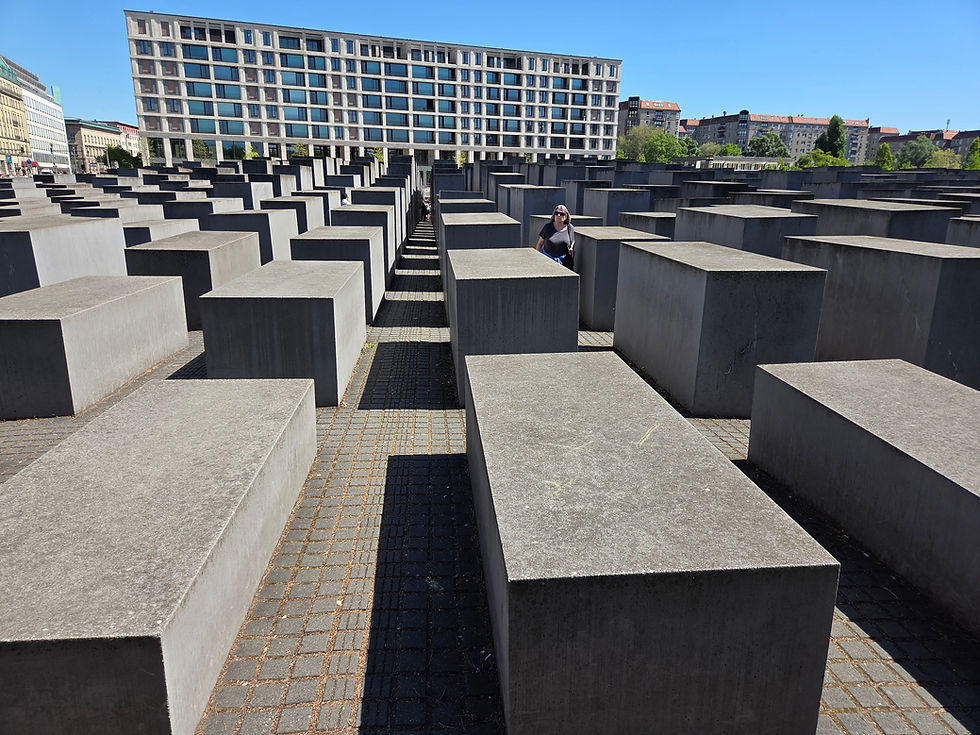
While on visit to Berlin in April 2026 I took a tour of the Holocaust Memorial. It is not a conventional war memorial in the traditional sense, but rather is enigmatic and purely abstract in design, almost so much so that it defies understanding.
Designed for a competition by Peter Eisenman, an American architect, and constructed in 2004 it challenges the viewer to process what they are seeing and feeling in the same way it challenges the viewer to comprehend what it represents – the killing of six million Jews by the Nazi regime during World War II. I believe Mr. Eisenman won the competition to design this memorial because of his ability to abstract mass murder committed on an industrial scale.
The Holocaust Memorial, mere meters from the Brandenberg Gate, is an array of 2,711 dark grey, almost black, concrete blocks that are arranged in a rectangular grid pattern and cover an undulating site of 1.9 hectares (almost 5 acres). The blocks or megaliths, some standing upright, others appearing as though they are half buried or lying on their sides, vary in height from .2 meters to 4.7 meters (several inches to 15 feet). They are approximately 1 meter wide and 2 meters long and are separated from one another by aisles and cross aisles also approximately 1 meter wide. The tops of these blocks form a wave on the landscape. Like the dead, these silent sentinels do not speak to us. There are no names, no mention of heroes - or villains, no dates, insignias, maps, engravings, signs or any other commemorative information typically accompanying war memorials. These sarsons create an undeniable prehistoric effect that begs the viewer to understand.

So, what does Mr. Eisenman want us to understand? What emotions does he want us to feel as we descend into and walk through the Holocaust Memorial? When standing deep in the center of the memorial, the blocks overwhelm the viewer with a sense of foreboding and death. The aisles, however, seem to have the opposite effect, giving the viewer a sense of hope and life. One can see the sky again as one emerges from this spatial contradiction. The death imagery is inescapable. The blocks, particularly the shorter ones, appear like crypts or sarcophagi that one might find in a cathedral or a pyramid. They are all neatly and precisely laid out in the typical efficient well organized Nazi manner, reminiscent of the hundreds of inmate barracks seen in
aerial photos of the death camps. The memorial, however, is not a labyrinth. One does not get lost in its depth since the end of each aisle is always visible – distant – but still visible.


I think it’s this duality of death and life, darkness and light, despair and hope captured in this memorial that makes it effective in conveying, in an abstract sense, the horror of the death camps and the relief the survivors must have experienced when they were finally liberated. It is not uncommon for architects to use metaphor and duality to give their designs depth and meaning and as a result create a richer and more meaningful user experience.
As a footnote, after leaving the memorial, I observed our tour guide, Maggie, telling several young children not to play on top of some of the shorter blocks. She understandably believed this activity was disrespectful. Initially, I agreed with her but after giving it more thought I think young children should not necessarily be encouraged to play this way but at the same time, not be discouraged either. I think that even in the death camps, surrounded by all the horror, children still played as children will do.
Maggie at Maggie the Tour Guide was an excellent guide, passionate, insightful, and very knowledgeable about German history and the historic sites in Berlin. I highly recommend her as a tour guide and would not hesitate to tour with her again!
Andrew Boer AIA
aboer@boerarch.com
Boer Architects, Inc.
Milwaukee, WI USA
bottom of page